Follow EmpireStateEB5 on Twitter
Follow EmpireStateEB5 on Twitter 1. 2.
Showing posts with label Investing. Show all posts

Wednesday, June 19, 2013

Wealthy Mexicans' Investment In The United States Increased in 2012

 
Mexican investment in the U.S. grew 11 percent in 2012, reaching $27.9 billion, the U.S. Embassy in Mexico City. The U.S. issued almost 4,000 investor visas to Mexicans in 2012, with only Japan and Germany exceeding that amount. Mexico and the U.S. have always had strong economic ties, though investment has traditionally flowed North to South, with U.S. companies outsourcing manufacturing operations to Mexico. In a balancing of the scales, Mexican businesses are now expanding north. The U.S. Embassy says that the U.S. is an attractive location for Mexican businesses and private investors.

Complete Forbes article: Wealthy Mexicans' Investment In The United States Sharply Up in 2012

Wednesday, May 22, 2013

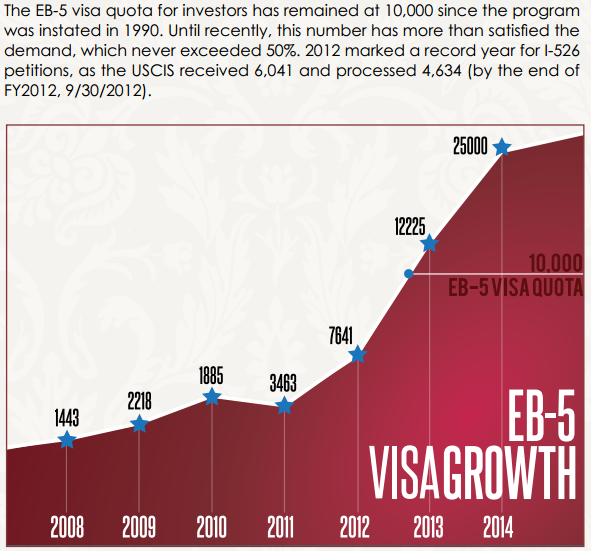
EB-5 Investor Immigration Visa Program Growth

With the increasing number of EB-5 visa being issued and only a limited amount will result in more competition for gathering investors in the EB-5 industry. The chart below shows how the EB-5 program has shown an increase of visas being processed and received since 2008 and representing projections for the years to come.


For more information on the USCIS EB-5 Immigration Investor program and investment options,


2815 Monroe Avenue, Suite 2100
Rochester, New York 14618
Tel: (866) 763-6515
                                                     EMAIL HERE or WEBSITE HERE

Wednesday, April 24, 2013

Foreign Buyers Show No Signs of Slowing


 [Source: By Jennifer LeClaire | Miami]

 There’s no slow down in the influx of foreign buyers in the commercial real estate arena. In fact, foreign investment in the U.S. factored as the third largest reason why confidence levels are increasing in 2013, according to Akerman Senterfitt.

The firm released its fourth annual survey after its U.S. Real Estate Summit. The survey found that 31% of commercial real estate executives believe foreign investors will fund a significant portion of commercial real estate debt and equity in 2013. And 62% believe that the U.S. will see the most Latin American real estate investment from Brazil. Venezuelan investors are expected to be the second most active, at 28%.

Meanwhile, 60% of percent of industry executives believe that foreign investors will contribute largely to the development of multifamily homes. They also predict that U.S. hospitality (30%) and retail (29%) will be among the top active sectors for foreign investment.


For more information on the USCIS EB-5 Immigration Investor program and investment options,

2815 Monroe Avenue, Suite 2100
Rochester, New York 14618
Tel: (866) 763-6515
                                              EMAIL HERE or WEBSITE HERE


Monday, April 1, 2013

EB-5 Immigration Investor Program Visa Details


[Source: State Department/USCIS/Washington Post]

The visual graph represents the total amount of EB-5 visas that have been issued since the inception of the the program back in 1992. The United States has issued more than 29,000+  EB-5 visas which has created over 50,000+ new US jobs and generated $6.8 billion in investment through the EB-5 program to date. From 2008 to 2013 (current) more than 70% of the issued visas were generated during this time frame. The year 2012 was the most productive year of the EB-5 program since 1992 and 2013 looks out grow the previous year visas.


For more information on the USCIS EB-5 Immigration Investor program, investment options, or basic program knowledge:


2815 Monroe Avenue, Suite 2100
Rochester, New York 14618
Tel: (866) 763-6515
                                              EMAIL HERE or WEBSITE HERE

Thursday, March 21, 2013

How long does it take to get money out of EB-5 investments?


One of the top questions in the mind of every prospective EB-5 investor is “How long does it take to get my money out of the EB-5 investment?” To answer that question, we have to examine that question from three primary perspectives: 1) immigration legal requirements for how long the investment must be maintained; 2) contractual legal restrictions; and 3) market, economic obstacles to cashing out of the investment.

USCIS requires that the $500,000 of investment funds and the program fee charged by the regional center be paid either into escrow, pending the approval or denial of the I-526 petition, or paid directly into the EB-5 enterprise before the I-526 petition can be filed. Therefore, the funds must be held in escrow or in the EB-5 project the entire time that the I-526 petition is pending, which can range from one month to one year. From recent experience in 2012 and 2013, the processing times have gone up from 4-6 months to 10-12 months. Once the I-526 petition is approved, USCIS requires that the investment be maintained until USCIS approves the I-829 petition to remove conditions from the conditional permanent residence. This means that we need to add another 3-6 months (sometimes longer) for consular processing of an immigrant visa or adjustment of status in the U.S. in order to begin the two-year period of conditional permanent residence. Then, in the final 90 days of the two-year period, the EB-5 investor must file the I-829 petition to remove conditions from the conditional permanent residence. It typically takes anywhere from 2 months to 10+ months for USCIS to decide the I-829 petition. So, if we figure the processing times on the longer end, with 10 months for the I-526 petition, 6 months for the consular processing, 2 years of conditional permanent residence, and 6 months for the I-829 petition, then we have 46 months, which is just 2 months short of 4 years. I generally tell clients to figure on 3.5 to 4 years to go through the EB-5 immigration process from start to finish, which is how long the client’s funds must be tied up due to immigration legal requirements.


Tuesday, March 12, 2013

USCIS releases draft EB-5 adjudication guidance


[Source: USCIS]

USCIS seeks your input on the draft policy memoranda listed below.

EB-5 Adjudications Policy Memorandum

Draft policy memoranda for comment are posted in the Feedback Opportunities page of uscis.gov, where stakeholders will be able to submit comments.These memos are drafts of proposed or revised guidance to USCIS Field Offices and Service Centers. They are not intended as guidance for the general public, nor are they intended to create binding legal requirements on the public. Until issued in final form, the draft memos do not constitute agency policy in any way or for any purpose.


Comment Process:  Please email all comments to opefeedback@uscis.dhs.gov.   Please include the following to make your comments clear:
  • State the title of the relevant memo in the subject line of your message;
  • Refer to a specific portion of the memo; 
  • Explain the reason for any recommended change; and 
  • Include data, information, or authority that supports the recommendation.
You must submit your comments before the closing date noted in the red box at the top of each policy memorandum. USCIS may distribute any comments received (including any personal information and contact information) on its public website or to those who request copies. By providing comments, you consent to their use and consideration by USCIS, and you acknowledge that your comments may become public. USCIS cannot guarantee that it will acknowledge or respond to any comments submitted.

See the Feedback Updates (also linked to the left) for the status of all policy memos and links to published memos.

Background and Additional Legal Information:  Field guidance documents are available for public review on USCIS's website (www.uscis.gov) as part of the Adjudicator's Field Manual (AFM).  In a continued effort to promote transparency and consistency in our operations, USCIS will periodically post policy memos for public comment to assist USCIS in improving immigration services.  USCIS will not post memos containing information that is law enforcement sensitive, confidential or otherwise protected from disclosure under the Freedom of Information Act.  USCIS is not required to solicit public comment on the draft policy memos under the Administrative Procedure Act. This informal comment process does not replace any statutory or other legal requirement for public comment on agency action.

Thursday, February 28, 2013

Highlights of Draft USCIS EB-5 Policy Memorandum


[Source: H. Ronald Klasko, Esq.]
USCIS issued its third draft EB-5 policy memorandum on February 14, 2013.  It is open for public comment through April 1, 2013.
While the draft policy memorandum technically does not establish USCIS binding policy, it is a window into its present thinking on various subjects relating to EB-5 adjudications.
This alert will discuss the highlights of the draft policy memorandum in terms of either new policies or clarifications of previously unclear policies.  It is not meant to be a summary of the entire memorandum, most of which merely restates existing law and policy.
It is important to note initially that the memorandum is not an exhaustive memorandum in that it does not cover most aspects of I-924 adjudications, including adjudications of EB-5 projects.  For example, it makes no reference to use of EB-5 money to pay back bridge financing; whether EB-5 loans can be paid back to a new commercial enterprise before conditions are removed; whether direct employees of the job-creating entity (indirect employees of the new commercial enterprise) must be “qualifying employees”; etc... 


To view the Draft of the USCIS EB-5 Policy Memorandum - READ ORIGINAL MEMO HERE


For more information on the USCIS EB-5 Immigration Investor program and investment options,

2815 Monroe Avenue, Suite 2100
Rochester, New York 14618
Tel: (866) 763-6515
                                              EMAIL HERE or WEBSITE HERE


Wednesday, February 6, 2013

USCIS EB-5 to move from California to Washington DC


[SOURCE: Suzanne (www.lucidtext.com) 2/3/2013]

USCIS Director Mayorkas sent an email last July announcing that USCIS would create a new office to oversee administration of the EB-5 program, and he discussed the proposal with stakeholders in December. I didn’t comment much at the time because the talk sounded preliminary and I didn’t expect to see action any time soon. But there has been action, as well as more talk, and I’m taking the plan seriously. Here are notes on what I know so far about the proposal. The details come from the 07/18/2012 Public Engagement email, the 12/03/2012 Conversation with the Director, and the 01/15/2013 National Stakeholder Engagement.
  • USCIS proposes a “realignment of responsibilities” for administration of the EB-5 Immigrant Investor program to a new EB-5 Program Office to be located in Washington DC.
  • Once operational, the office will deal with I-924 applications and I-526 and I-829 petitions. Only the I-485 will be handled elsewhere.
  • The agency intends to accomplish the realignment very swiftly, with the goal to have the new EB-5 program office up and running and evaluating cases by June 2013. Applicants and petitioners will continue to work with the California Service Center until the shift occurs.
  • The new office will be led by a new Chief of Immigrant Investor Programs. The program chief will have significant experience in the business world and will assume responsibility for ensuring that the program is administered efficiently, with integrity, with predictability, and with an understanding of today’s business realities. The chief of new EB-5 program office will report directly to Deputy Director of the agency. Robert Cox of the USCIS Office of Chief Counsel has been named as acting chief of the immigrant investor program during the bridge period.
  • The new EB-5 program office will be staffed with personnel with economic, business, and legal expertise and experience. This includes the adjudicators themselves as well as policy personnel.
  • The staff will include dedicated staff drawn from other components within agency, including full-time public engagement resources, legislative affairs resources, and personnel from fraud protection and national security.
  • It hasn’t been decided yet whether there will be there be specialized adjudicators, counterparts to “the economist,” the “lawyer,” the “business specialist” and so on. Director Mayorkas likes the idea of a team specializing in project-eligibility and another team specializing in client eligibility. The question is how precisely to divide the specializations, and which areas of the adjudication process would most benefit from dedicated specialists. (The EB-5 team at the CSC currently has over 50 dedicated staff, including 40 service officers and supervisors, eight economists, and two securities attorneys.)
  • The new program office will incorporate channels of direct communication with the review board team. Email is expected to be the primary channel. The hope is “to divorce ourselves from the static institutional model of communication” between adjudicators and applicants and to achieve a greater fluidity of communication.
  • Director Mayorkas has in mind a goal of reaching 90-120 day processing times, including for I-924 applications.
The Ombudsman’s office is holding an engagement on March 5th that will discuss the “new EB-5 adjudication unit in Washington, D.C.” among other matters. Stakeholders are invited to submit written comments by February 15th.

With comprehensive immigration reform on the table, the EB-5 program may be up for changes even beyond the realignment of responsibilities to Washington DC. See: President Obama Addresses the EB-5 Regional Center Program Legislative Update: Prospects for Immigration, and EB-5 Program, Reform


Friday, February 1, 2013

President Obama’s Statements on EB-5 Could Signal Expansion of Program


[Source: Laura Foote Reiff, Greenberg Traurig, LLP]

During his speech on January 29 in Las Vegas, President Obama announced his principles for Comprehensive Immigration Reform. As part of the president’s plan to overhaul the current broken immigration system, he noted the need to make permanent the EB-5 Regional Center Program that is currently set to expire on September 30, 2015. The program was introduced in 1992 and implemented in 1993. Since that time, it has continually been reauthorized by Congress on a temporary basis.

The president’s objectives related to the program include:
  • Expanding opportunities for investor visas and continued U.S. economic development
  • Permanently authorizing the EB-5 regional center program
  • Providing incentives for visa requestors to invest in programs that support national priorities, including economic development in rural and economically distressed regions
  • The introduction of new measures to combat fraud and national security threats within the program
  • Data collection on the economic impact of the program nationally and locally
  • The creation of a pilot program for state and local government officials to promote economic development.


Investing In Citizenship: For The Rich, A Road To The U.S.


The article below provides heart felt stories of real EB-5 immigrant investors and reasons they made the decision to live in the United States. Top reasons for immigrants investing in the United States Citizenship and Immigration Services (USCIS) EB-5 Immigration Program are: Educational Institutions and costs, start their own business, spouse and unmarried children 21 and under receive green cards, and lifestyle change.

[Source: NPR Staff; Published January 26, 2013]

The traditional immigrant story is a familiar one.

Someone who longs for a better life makes the tough journey, leaves behind the hardships of his or her native land and comes to the United States to start again. That story, in a lot of ways, helped build this country.

These days, however, there's a very different kind of immigrant who wants to come to this country — the rich — and they have a different set of dreams.
Anthony Korda was a barrister, or lawyer, in England who vacationed frequently in the U.S. with his family.

"Each time we left the nice weather of Florida, we were more depressed about having to leave," Korda tells NPR's Robert Smith.

Korda says they did not look forward to slogging through the London rain, so he made a lifestyle choice: He was going to immigrate to the U.S. and live in a place where you could get a real tan.

Korda found pretty quickly, though, that the last thing the U.S. needed was more lawyers, so a standard or employment-based visa was unlikely. But then he saw a shortcut to becoming an American in a small, obscure federal program called EB-5, designed for people like him to get into the country — if they had enough money.

"It looked too good to be true," he says.

All Korda had to do was cash out most of his savings — about $500,000 — and invest in an American business. If he could help create 10 jobs, then he would get a green card.

Korda's investment was a ski resort in Vermont that was looking to improve its infrastructure. So he put down his money and got to move to Florida and vacation in Vermont. He and his family got the American dream, but what did America get in return?

Continue reading article here: Investing In Citizenship: For The Rich, A Road To The U.S.


Monday, January 28, 2013

USCIS: Ombudsman EB-5 Stakeholder Meeting March 5, 2013

 The EB-5 Program Immigrant Investor Program
Tuesday, March 5, 2013
1:30 pm to 4:00 pm (Eastern)
Washington, D.C.


Citizenship and Immigration Services Ombudsman Maria Odom will convene an EB-5 Immigrant Investor Program stakeholder meeting in Washington, D.C. on Tuesday, March 5, 2013 from 1:30 pm to 4:00 pm (Eastern).
USCIS has been working to reform the EB-5 program and plans to soon establish a new EB-5 adjudication unit in Washington, D.C.  As the Ombudsman’s Office continues to track progress with the EB-5 program, this is an ideal time for stakeholders to discuss ongoing issues with policies, procedures, and other matters.

Opportunity to Submit Written Statements (Optional)
The Ombudsman’s Office encourages stakeholders to provide written statements on issues of concern in advance of the March 5th meeting.  This feedback will assist us in identifying and addressing existing program challenges.  Written statements may be provided independent of registration for the meeting.
Written statements should be limited to 5 pages, and provided to the Ombudsman’s Office by emailing Cisombudsman.PublicAffairs@hq.dhs.gov.  Please reference “EB-5 Statement” in the subject line of the email message.  These statements are due no later than February 15th.  Written submissions will be considered confidential except as subject to applicable law, such as the Freedom of Information Act (FOIA).

Registration
This event will be limited to 100 in-person participants.  Please RSVP by sending one email per participant to Cisombudsman.PublicAffairs@hq.dhs.gov  and reference “EB-5 Meeting” in the subject line. In the body of your email message, please provide the following information:

Name:
Organization:
Contact E-mail:

The Ombudsman’s Office will confirm your registration.  The final list of in-person attendees will close on February 15th.

Sincerely,
Office of the Citizenship and Immigration Services Ombudsman
U.S. Department of Homeland Security
cisombudsman.publicaffairs@dhs.gov

Wednesday, November 28, 2012

USCIS EB-5 Engagement on December 3, 2012

(Source: USCIS)

 "Dear Stakeholder,

U.S. Citizenship and Immigration Services (USCIS) invites interested parties to participate in a conversation with USCIS Director Alejandro Mayorkas regarding the EB-5 Immigrant Investor Program on Monday, December 3, 2012 from 2:00 p.m. to 4:00 p.m. (Eastern). During the engagement, Director Mayorkas will discuss EB-5 policy and procedural issues and take questions from participants.  

To Participate in the Session:
You may attend this engagement either in person or by teleconference. However, those attending via phone will be in listen-only mode. If you wish to attend in person, attendance is limited to the first 100 people who register. To register, please email the Public Engagement Division no later than Friday, November 30, 2012 at Public.Engagement@uscis.dhs.gov.

If you plan to attend in person, please reference “EB-5 Conversation – In Person”
If you plan to attend by phone, please reference “EB-5 Conversation – Phone”

To Join the Session:
Following registration, we will confirm your attendance in person or by telephone. If you are attending in person, please be sure to bring photo identification and arrive at least 15 minutes early to allow extra time to complete the security process. If you are attending by phone, please use the information below to join the session.

Call-in Number: 1-888-324-8192
Passcode: EB5
 
Kind Regards,
U.S. Citizenship and Immigration Services" 
Follow EmpireStateEB5 on Twitter