Follow EmpireStateEB5 on Twitter
Follow EmpireStateEB5 on Twitter 1. 2.
Showing posts with label Immigration. Show all posts

Tuesday, July 9, 2013

Over the Years Wealthy Mexicans Are Increasing Investment in EB-5

 
Over the past few years Mexico and Central American countries have seen wealthy citizens investing in the United States mainly by the means of the USCIS EB-5 Program. Since 2011 to 2012 the number of investor South of the Border have doubled and only to increase with investors in the years to come. Mexican investment in the U.S. grew 11 percent in 2012, reaching $27.9 billion, said the U.S. Embassy in Mexico City. A main reason wealthy Mexicans are leaving (or as they refer to it as an "Exodus") is the increasingly violent acts from the Drug Cartels. With this rising fear of the Drug Cartels, the individuals and families with the means to invest in a EB-5 Regional Center are doing so. 

Empire State EB-5 has established an office and legal representation in Mexico City to support our on going efforts with our EB-5 investors and providing investor projects that are diverse in both industry and project type so we can offer several options (Healthcare, Hospitality, Manufacturing, Agriculture). 

Interests in understanding the current process and procedures in the EB-5 industry and projects available, contact Empire State EB-5 directly.


                                                                      (866) 763-6515


Thursday, June 20, 2013

More Chinese immigrants move to developed economies


[By Fu Jing in Brussels ( chinadaily.com.cn)]

The number of Chinese immigrants to developed economies has picked up slightly from 2009, and made China the "leading country of origin" according to a report published on Thursday in Brussels.

But given its 1.4 billion population, the rate is far lower than most other countries in the world. And its ability and insight into attracting expertise has won warm appreciation from the OECD chief.

As the Paris-based Organization for Economic Cooperation and Development released the International Migration Outlook 2013, the organization's secretary- general Angel Gurria praised China for implementing "very smart" measures to attract expertise. 

China's immigration into OECD countries reached 529,000 in 2011.

In 2009 the number declined to 460,000 from 518,000 in 2007. 

Based on 2011 figures, major immigration countries following China are Romania, Poland, India, Mexico, Philippines, United States, Germany, Morocco and the UK, each of which all has immigration of above 100,000.

See complete report: Slight rise in Chinese immigrants to developed economies


Monday, June 10, 2013

Chinese with high net worth emigrating overseas consider the EB-5 program


A few main reasons for Chinese to consider USCIS EB-5 program:
  1. Diversifying investments; with tough governmental restrictions on Chinese real estate market and declining gold price,  many Chinese investors are considering international investment strategies. Investing in foreign real estate, including residential properties, is a top priority approach for many investors.
  2. Sending children for a better education; many Chinese teens are coming to private high schools in the US. Currently there are nearly 200,000 Chinese students enrolled in the US schools, colleges and universities.
  3. Avoiding potential social and political instabilities; with a new regime in power, many wealthy investors feel more uncertainty and discomfort about which direction China is to be headed. The vast gap between the rich and the poor has further pushed the investors for outbound opportunities.
  4. Seeking a better life; with numerous reports on food safety issues, environment pollution problems across China, Chinese investors are simply searching for exit strategies.

Empire State EB-5 Regional Center has projects ranging from the healthcare to manufacturing to bio-technology industries. Contact us today to gather more information on these exciting new projects.
2815 Monroe Avenue, Suite 2100
Rochester, New York 14618
Tel: (866) 763-6515
                                                     EMAIL HERE or WEBSITE HERE

Wednesday, May 22, 2013

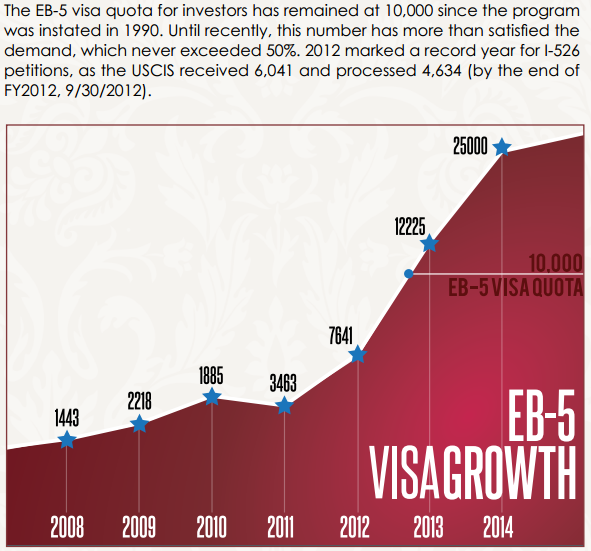
EB-5 Investor Immigration Visa Program Growth

With the increasing number of EB-5 visa being issued and only a limited amount will result in more competition for gathering investors in the EB-5 industry. The chart below shows how the EB-5 program has shown an increase of visas being processed and received since 2008 and representing projections for the years to come.


For more information on the USCIS EB-5 Immigration Investor program and investment options,


2815 Monroe Avenue, Suite 2100
Rochester, New York 14618
Tel: (866) 763-6515
                                                     EMAIL HERE or WEBSITE HERE

Monday, May 20, 2013

USCIS ELIS and the EB-5 Immigrant Investor Program Invitation - May 23, 2013


(Source: USCIS)  U.S. Citizenship and Immigration Services (USCIS) invites you to participate in a conversation regarding USCIS ELIS and the EB-5 Immigrant Investor Program on Thursday, May 23, 2013, from 12:30 p.m. to 2 p.m. (Eastern). 

Form I-526, Immigrant Petition by Alien Entrepreneur, will be the first of the EB-5 forms available for e-filing in USCIS Electronic Immigration System (ELIS). At the March 28th stakeholder teleconference, we heard concerns about multiple investors submitting the same documentation with the Form I-526. To address this concern, we plan to add a “document library” to USCIS ELIS later in the year. The document library will allow Form I-526 petitioners to share documents related to a new commercial enterprise that were previously submitted with an approved I-924, Application for Regional Center, rather than submitting these same documents with the Form I-526. During this engagement, USCIS officials will give an overview of the concept for the document library and solicit feedback regarding managing access to the document library; uploading and storing documents; and Regional Center and Investor expectations. 

To Participate in the Session:
You may attend this engagement either in person or by teleconference. If you wish to attend in person, attendance is limited to the first 25 people who register. Those attending via phone will be in listen-only mode. 

To Join the Session in Person:

If you wish to attend in person, please email Public.Engagement@uscis.dhs.gov no later than May 22, 2013. Please include your full name and the organization you represent, if any, in the body of the email and reference “ELIS EB-5” in the subject line. Also, be sure to bring government-issued photo identification and plan to arrive at least 15 minutes early to complete the security process. 

To Join the Session by Phone:

If you wish to attend by phone, please visit our registration page to register for this engagement. All registrations must be received no later than May 22, 2013. Be sure to complete and update your subscriber preferences by answering all questions on the “Event Registration” tab. Once your registration is processed, we will confirm your attendance in person or by telephone. If you have any questions regarding the registration process or if you have not received a confirmation email within 2 business days, please contact the Public Engagement Division at Public.Engagement@uscis.dhs.gov.

On the day of the session, please use the information below to join the teleconference. We recommend that you call in 10 to 15 minutes before the start time. 

Toll-Free Call-in Number: 1-800-857-0174      Passcode: ELIS


Wednesday, May 15, 2013

Top Five EB-5 Industry Sectors in Chinese Market


[Source: EB5NewsBlog]

There are various EB-5 projects available to Chinese investors this year, they range from casino hotels, mixed-use developments, charter schools, dental clinics to high end apartments. However, considering project's marketability and popularity, the following categories are getting attentions from Chinese investors:

1) Large full service hotels with well-known or international brands;

2) Large scale mixed-use real estate development projects in large metropolitan areas;
3) Direct EB-5 projects with top brand franchises;
4) Assisted living and memory care facilities; and

5) High end apartment development projects in large metropolitan areas


For more information on the USCIS EB-5 Immigration Investor program and investment options,


2815 Monroe Avenue, Suite 2100
Rochester, New York 14618
Tel: (866) 763-6515
                                                     EMAIL HERE or WEBSITE HERE


Thursday, May 9, 2013

Three out of five wealthy Chinese want to immigrate


[Source: Jason Chow; WSJ]

China’s rich continue to want to invest and move abroad in large numbers, but their goals have begun to shift, consulting firm Bain & Company said in a report released Tuesday.

Three out of five wealthy mainland Chinese are looking to immigrate out of China while another third own investments abroad, Bain said in its “China Private Wealth Report, 2013,” based on a survey conducted earlier this year of 3,300 “high-net-worth individuals” with at least 10 million yuan (US$1.6 million) in investable assets.

Jennifer Zeng, the lead author of the report, said the desire for overseas immigration and investment is a defensive measure for China’s rich. “The more they look for risk diversification, the more they look elsewhere,” said Ms. Zeng in a phone interview from Beijing.

She pointed out that the proportion of wealthy Chinese with overseas investments has doubled to 33% since 2011, the last time the survey was completed. Among the ultra-high-net-worth Chinese – those with at least 100 million yuan of investable assets – 51% said they had money invested overseas.

Read entire article:  Three out of five Chinese want to immigrate


Monday, April 22, 2013

Key EB-5 Issues Contained in the Senate Comprehensive Immigration Bill Introduced on April 17, 2013


[Source: Laura Reiff and Kate Kalmykov, www.eb5investors.com]

The key EB-5 provisions in the bill include:

-Making permanent the EB-5 Regional Center program.  Introduced in 1992 as a “pilot” program, it has continually been reauthorized by Congress and most recently it was extended through September 30, 2015. 

-Recapture of unused immigrant visa numbers from prior fiscal years. 

-Elimination of per country quotas for employment based visa numbers, this would have 
significant implications for China which is predicted to reach its quota in fiscal year 2014.

-Exemption from the employment based immigrant visa numbers for spouses and children of principal applicants, this means that visa numbers which are currently capped at 10,000 would be allocated solely to principal investors.

-Additional immigrant visas numbers for the EB-5 program as a whole.

Full "Gang of Eight" Legislation Immigration Reform 


Tuesday, April 9, 2013

Funding Hotel Development Projects with EB-5 Capital


[Source: ILW.com]

When the financial crisis made it more difficult to acquire financing through traditional venues, hotel developers started turning to the Federal  USCIS EB-5 program for sources of capital. Since 2008, developers for hotel chains such as Hilton Worldwide, Hyatt Hotels, and Starwood Hotels & Resorts Worldwide, have taken advantage of the influx of foreign funds made available through the EB-5 program. 

There are two ways for a foreign entrepreneur to obtain an EB-5 investment visa: investing $1 million into a new commercial enterprise to be run directly by the foreign national in the U.S., or to invest into a “regional center.” The latter is an economic unit that is privately owned or sponsored by the government, and will manage the investment, assisting the investor in complying with U.S. Citizenship and Immigration Services (USCIS) requirements—including job creation.  Since most regional centers are located in “Targeted Employment Areas,” they usually qualify for the lower investment amount of $500,000, another reason that they are attractive to the EB-5 investor. Regional Centers also have a less stringent job creation requirement that allows for indirect job creation. 

Since hotels create both, direct jobs (managers and house keeping for example) and indirect jobs (suppliers of towels and soaps), they are a good fit for foreign investors whose permanent resident status is dependent on meeting the USCIS requirements. Pairing with a regional center also benefits the hotel developers since they assist with business plans and help to attract foreign investors. 


Hotel Developers or Project Developers contact us directly with interest or more information to how EB-5 financing can be a part of you next venture.

2815 Monroe Avenue, Suite 2100
Rochester, New York 14618
Tel: (866) 763-6515
                                              EMAIL HERE or WEBSITE HERE


Friday, April 5, 2013

More than a Green Card for Sale, the EB-5 Program is Good for America!


(Author: K. Lara Baharlo, Esq., Of Counsel, Wolfsdorf Immigration Law Group, Original article HERE) 

In 1990 Congress created the employment-based fifth preference visa category (EB-5) category for foreigners seeking to invest in a business that will benefit the US economy and create or preserve at least 10 full-time jobs for qualified US workers. The amount required to invest is $1 million or $500,000 if the investment is made in a high unemployment or rural area.

Some portray the typical EB-5 investor as an ultra-rich Chinese businessman in the market for a prestigious US green card. One restrictionist group describes EB-5 as a “tacky, troubled program that doesn’t do much for economic development.” Others say the EB-5 program “let[s] the guys in with the money and leave[s] the best and brightest waiting in line.” Meanwhile, participants in the program have their own criticisms, alleging that US Citizenship and Immigration Services (USCIS) is hostile toward EB-5 because it is viewed as a “green card for sale” program that denigrates the US immigration system, and is essentially bad for America.

A fundamental tenet of the EB-5 program is job creation, which is often minimized by program critics. There are economic citizenship programs available in some countries through which an individual can buy a passport for a price. However, the EB-5 program requires much more in that the investment required to put one on the path to permanent residency must, amongst other things, create jobs and be at risk. As such, the “green card for sale” concept is flawed and oversimplifies the EB-5 process.

According to statistics published by IIUSA, the industry trade association for the EB-5 Regional Center Program, almost 100,000 jobs have been created for US workers through the EB-5 program, with nearly $5 billion in capital infused into job creating enterprises in the United States since 2005. These figures should be viewed against an increasingly common backdrop of outsourcing and offshore back-office operations. Should we not welcome a program that creates US jobs and infuses a lagging economy with much needed capital? Already, the US must compete with investor programs that are more attractive due to better administration and less stringent requirements. Although some of these programs are more expensive, they can offer passive investment opportunities and shorter processing times with a higher degree of certainty that the investor will achieve his or her goal of residency.

Yes, the EB-5 program has endured fraud and abuse, but scams and deception are not unique to EB-5. Yes, some Regional Centers have failed to deliver on their promises, and investors and projects have suffered. However, the need for weeding out bad actors must be balanced by the need to provide a predictable and stable program for those with legitimate interests so that the United States can continue reaping the significant benefits of attracting foreign investors, particularly during this time of economic struggle and uncertainty.

America is no longer the overwhelmingly dominant global superpower, and cultural arrogance is not a platform from which to operate a congressionally mandated program. However, the United States is still considered the “land of opportunity” throughout the world and can provide excellent educational and quality of life options for high net worth individuals and their families. Although painful to admit, the US cannot afford to deter the billions in capital and hundreds of thousands of jobs that result from EB-5 investment.

Now is the time for the United States to encourage entrepreneurs, capital inflow and job creation. The EB-5 program is smart business, and the United States should be a world leader in attracting immigrant entrepreneurs who are ready and willing to take on the challenge of making it as investors and job creators in America.
 (Ms. Baharlo can be contacted at lbaharlo@wolfsdorf.com; Original article HERE)

Monday, March 25, 2013

The EB-5 American Dream

[Source: State Department/Wall Street Journal]

The surge for visas that were issued in the past 5 year through the USCIS EB-5 program are represented in the graph above. South Korea was the majority of visas issued back in 2008, but since that time China has made an extreme jump to the top representing 4/5 of the programs issued EB-5 visas. 


For more information on the USCIS EB-5 Immigration Investor program and investment options,

2815 Monroe Avenue, Suite 2100
Rochester, New York 14618
Tel: (866) 763-6515
                                              EMAIL HERE or WEBSITE HERE


Thursday, March 21, 2013

How long does it take to get money out of EB-5 investments?


One of the top questions in the mind of every prospective EB-5 investor is “How long does it take to get my money out of the EB-5 investment?” To answer that question, we have to examine that question from three primary perspectives: 1) immigration legal requirements for how long the investment must be maintained; 2) contractual legal restrictions; and 3) market, economic obstacles to cashing out of the investment.

USCIS requires that the $500,000 of investment funds and the program fee charged by the regional center be paid either into escrow, pending the approval or denial of the I-526 petition, or paid directly into the EB-5 enterprise before the I-526 petition can be filed. Therefore, the funds must be held in escrow or in the EB-5 project the entire time that the I-526 petition is pending, which can range from one month to one year. From recent experience in 2012 and 2013, the processing times have gone up from 4-6 months to 10-12 months. Once the I-526 petition is approved, USCIS requires that the investment be maintained until USCIS approves the I-829 petition to remove conditions from the conditional permanent residence. This means that we need to add another 3-6 months (sometimes longer) for consular processing of an immigrant visa or adjustment of status in the U.S. in order to begin the two-year period of conditional permanent residence. Then, in the final 90 days of the two-year period, the EB-5 investor must file the I-829 petition to remove conditions from the conditional permanent residence. It typically takes anywhere from 2 months to 10+ months for USCIS to decide the I-829 petition. So, if we figure the processing times on the longer end, with 10 months for the I-526 petition, 6 months for the consular processing, 2 years of conditional permanent residence, and 6 months for the I-829 petition, then we have 46 months, which is just 2 months short of 4 years. I generally tell clients to figure on 3.5 to 4 years to go through the EB-5 immigration process from start to finish, which is how long the client’s funds must be tied up due to immigration legal requirements.


Thursday, March 14, 2013

What’s positive with the EB-5 Immigration Investor Program


[Source: Suzanne, www.lucidtext.com]

To close a week of complaining about what’s wrong with the EB-5 program, I’d like to conclude with pointing out that the EB-5 program has been functioning, despite the challenges.  Even in 2012, when many of the processing problems that we complain about came to a head, USCIS still approved 3,677 new EB-5 immigrant petitions and verified successful job creation and granted permanent residence to 736 investors. (See my FY2012 stats post for detail.)  Those numbers represent half a million to a million dollars per investor going into US businesses and 10+ verified jobs created per investor. Those numbers are not small, despite all the problems. You’ll recall that the US Department of State issued a record total of 7,641 EB-5 visas to investors and their families in FY2012, prompting fears that EB-5 visa usage might approach its limit for the first time ever...


Monday, March 4, 2013

China's billionaires on rise


[Source: WANG ZHUOQIONG - China Daily]

China has had more billionaires created by its stock markets this year than in the United States - 212 compared with 211 - a new survey revealed on Thursday.

According to the latest Hurun Global Rich List 2013, there were 1,453 people in the world with personal wealth of $1 billion or more at the end of January.

Another significant sign of more wealth being created in the East came with figures showing Asia was home to the highest number of billionaires, with 608, followed by 440 from North America and 324 from Europe, said Hurun researchers.

Among individual countries, the US and the Greater China area dominated with 408 and 357 respectively, followed by Russia, Germany and India. 

Between them, the US and China now have half of all billionaires on the planet.
Moscow, with 76 billionaires, is the billionaire capital of the world, followed by New York, Hong Kong, Beijing and London, according to the report. 


Thursday, February 28, 2013

Highlights of Draft USCIS EB-5 Policy Memorandum


[Source: H. Ronald Klasko, Esq.]
USCIS issued its third draft EB-5 policy memorandum on February 14, 2013.  It is open for public comment through April 1, 2013.
While the draft policy memorandum technically does not establish USCIS binding policy, it is a window into its present thinking on various subjects relating to EB-5 adjudications.
This alert will discuss the highlights of the draft policy memorandum in terms of either new policies or clarifications of previously unclear policies.  It is not meant to be a summary of the entire memorandum, most of which merely restates existing law and policy.
It is important to note initially that the memorandum is not an exhaustive memorandum in that it does not cover most aspects of I-924 adjudications, including adjudications of EB-5 projects.  For example, it makes no reference to use of EB-5 money to pay back bridge financing; whether EB-5 loans can be paid back to a new commercial enterprise before conditions are removed; whether direct employees of the job-creating entity (indirect employees of the new commercial enterprise) must be “qualifying employees”; etc... 


To view the Draft of the USCIS EB-5 Policy Memorandum - READ ORIGINAL MEMO HERE


For more information on the USCIS EB-5 Immigration Investor program and investment options,

2815 Monroe Avenue, Suite 2100
Rochester, New York 14618
Tel: (866) 763-6515
                                              EMAIL HERE or WEBSITE HERE


Follow EmpireStateEB5 on Twitter